

- A healthtech platform that automates documentation from physician-patient conversations captured with Plaud devices
- An AI coaching product that uses Plaud devices to capture conversations for agents to use as context
- A sales platform that captures offline sales meetings with Plaud devices

Why Plaud Embedded?
1. Purpose-built Devices for Capturing Audio
Plaud devices were built to capture conversation-based work. Rather than forcing users to record conversation using your phone directly, Plaud devices have:- Long-lasting batteries so your users don’t need to drain their phones
- Higher-quality microphones that can pick up on conversations feet away
- 64 GB storage with encryption so audio data can be held locally and shared only when users want
- Light and convenient designs that don’t take away from your users’ in-person experiences

Plaud Note Pro
Designed for phone calls and conversation-heavy workflows.

Plaud NotePin S
Designed for hands-free, on-the-go use in field work, healthcare, and retail.
2. State-of-the-art Speech-to-Text Pipeline
Plaud’s Automatic Speech Recognition (ASR) models were trained to be able to accurately attribute speakers and transcribe audio even with background noises, overlapping speakers, different languages (100+), and distance from mics.
How it Works
Plaud Embedded’s architecture has 4 main components:- Your backend services
- Your mobile app
- Plaud devices
- Plaud’s cloud services
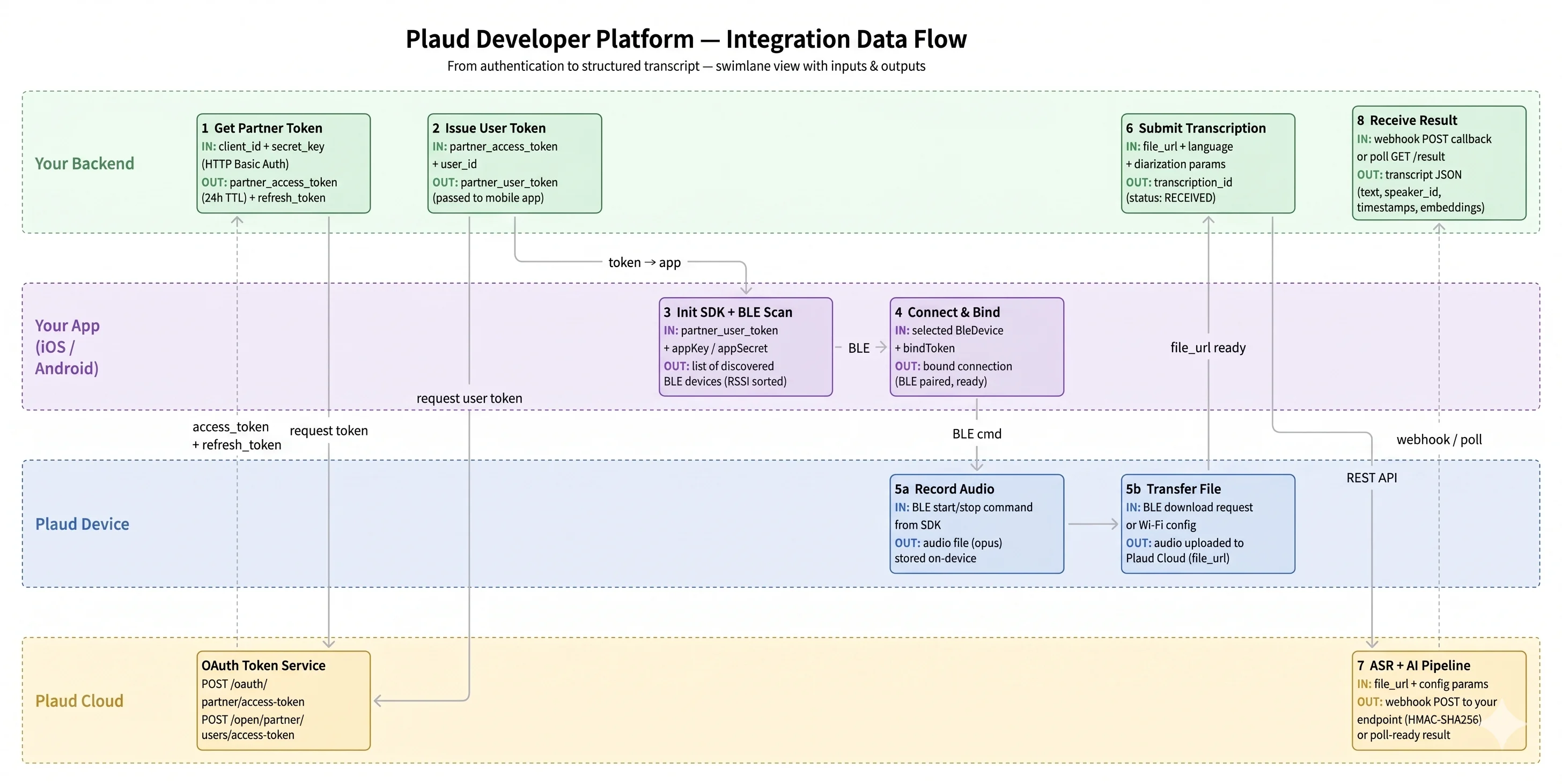
1
Retrieve user token
Your backend services exchanges
client_id and client_secret for a valid user token from Plaud’s cloud services.2
Use token to initialize the Plaud Embedded SDK
Pass the user token to your mobile app to connect and bind your users’ Plaud device
Each of your users’ unique Plaud devices can only be bound to one app. This is necessary for offline encryption so even if a device is stolen, the data remains inaccessible.
3
Sync recordings and receive transcriptions
Sync audio files from Plaud devices to your backend either through BLE (Bluetooth Low Energy) or Wifi connection. Pass the
file_url to Plaud’s cloud services to receive the full transcription via Plaud’s Transcription API.Key Definitions
Frequently asked questions
Do my users need a Plaud App subscription to use the SDK?
Do my users need a Plaud App subscription to use the SDK?
No. With the SDK, Plaud acts as infrastructure for your product — you pay for transcription usage and the number of connected devices, and you own the product experience and pricing for your app.
Why not build a phone recording app ourselves?
Why not build a phone recording app ourselves?
Phones are not designed for capturing in-person conversations, nor can they capture phone calls without significant effort. They also drain the phone battery, create an awkward end-user experience, and lack built-in state-of-the-art transcription. Plaud devices and the SDK address all of this.
Do I need to have a mobile application?
Do I need to have a mobile application?
Yes. The Plaud Embedded SDK integrates directly into your iOS or Android application. Your app handles device pairing, recording controls, and user experience — Plaud provides the SDK, transcription API, and a starter app to build from.
What languages are supported?
What languages are supported?
112 languages, with published accuracy benchmarks by language, scenario, and environment.
Are there usage limits on the Free tier?
Are there usage limits on the Free tier?
Free tier accounts have 300 free transcription hours and 50 free connected devices per client. See our billing section for more information.